
Work

“Swinging under the Trees”. The Haiǁom call this remote and sandy area ǀGom Ais, “place of many manketti trees”. According to their oral history it was once a seasonal refuge with pans and hollow trees as a water source. Mangetti Block, Oshikoto Region. September 2019

“Dappled Shade”. !Uoa !Ga-ǀham and her grandson take a nap under the shade of a tree. Blouberg Resettlement Farm (ownership contested), Omaheke Region. October 2019

“Kindred Care”. Too frail to join the women in search of veldkos, Koba Kxwara rests in dappled shade, guarded by her grandson. Nǂama Pan, Nyae Nyae Conservancy, Otjozondjupa Region. October 2021

“Quills”. David ǀAnǀao, a young hunter from the Makuri Village, wears his trophy for having dealt the fatal blow in a joint porcupine hunt. Makuri Village, Nyae Nyae Conservancy, Otjozondjupa Region. September 2019
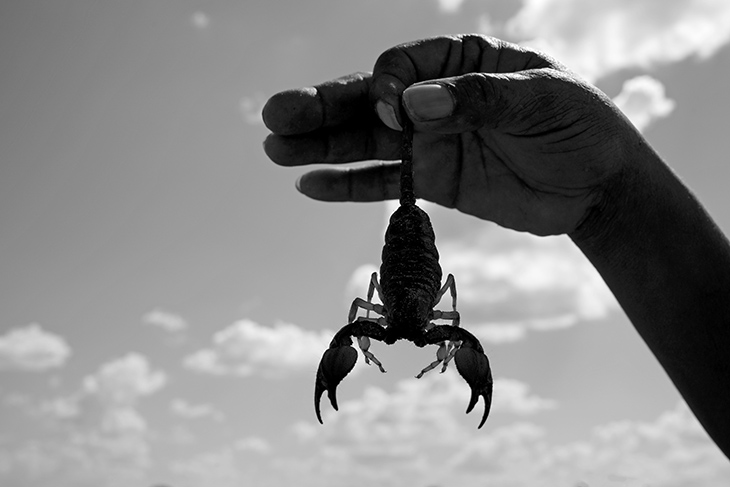
“Scorpion” at Gautcha Pan, Nyae Nyae Conservancy. May 2026

“The Classroom”. Chief Sofia Jacob Primary was originally built by the German government as a private school and hostel for 80 Bushmen children. Their own needs are increasingly being eclipsed by those of children from other language groups who have severely compromised the institution’s capacity. Corridor 17-B, Omaheke Region. March 2019

“What Awaits Her?” Five-year-old Sofia Skoen dreams of a better life – one without hunger and deprivation. Skoonheid (“Beauty”) Settlement. Omaheke Region. April 2019

“When I was Young” … Katrina Nxase (b. 1944). Epukiro was historically inhabited by the Bushmen. The Administration of the 1920s considered it unsuitable for settler ranching and declared it a Herero reserve. The new occupants soon requested that the “snakes” still residing there “be removed”. Epukiro Pos-3, Omaheke Region. October 2019

“All I have is Smoke”. ǀAsa !Amace.While drawing on her pipe, 69-year old ǀAsa laments All I have is Smoke; our government has failed us. She recalls being taken by military truck from her birth place at Karakuwisa at age 10 to be resettled at Nhoma. She was then forcibly relocated to her present home, a shack settlement intended for Bushmen, where more often than not, water pumps are dysfunctional and where illegal cattle herders are gaining control. Grashoek, Nǂa Jaqna Conservancy,Tsumkwe West. September 2019

“Smoking the Pot”. ǂ’Oo!’au (recorded as Be Bo on her official identity document) was born in the veld near Tsumkwe in 1950. Gǂaingǂog Village, Ojozondjupa Region. September 2019

“Mortar Shell and Pestle”. A Haiǁom elder Maria Guoho (b. 1939 on Plaas Ses) smokes her just-pulverised tobacco. Her parents were “relocated” from Etosha Pan when it was declared a national park. Plaas Ses, Oshikoto Region. September 2019

“The Devil’s Claw”. Nǃoe ǀUi, a Juǀ’hoan woman, dries Devil’s Claw (Harpagophytum procumbens) tubers, a herbal supplement to treat a wide range of ailments, for the overseas market. Djokhoe Village, Nyae Nyae Conservancy, Otjozondjupa Region. September 2019

“The Strike #1”. Thamaro Bessa, a ‘Nǀohan woman, looks after the defunct Saa Ta Ko Campsite (meaning “We rest”), once an empowerment project for the Naro, !Xoon and ‘Nǀohan communities. Corridor 17-B, Omaheke Region. March 2019

“Snared”. Hunter-gatherer ǂOma Kashe procures a springhare for his large family. Nyae Nyae Conservancy, NE Kalahari. October 2021

“Singing the Rain”. Selma Jacobs performs a traditional Rain Dance across the barren Omongwa (“Salt”) Pan. Aminuis, Omaheke Region. October 2019

“The Water Point in a Salt Storm”. A whirlwind whips up across the Omongwa (“Salt”) Pan and catches Prescilla Xhao and her family in chaos at the water well as they scatter for an imaginary shelter. Aminuis, Omaheke Region. March 2019

“The Wheelbarrow”. Jakugberug Kavari, Kumbaza Xhao and their kids pull water home. Omongwa (“Salt”) Pan, Aminuis, Omaheke Region. March 2019

“Inner Impulse”. Koba Kxwara (b. 1935) plays the ǁxoashe, the Juǀ’hoan name for a traditional guitar. Nǂama Pan, Nyae Nyae Conservancy, Otjozondjupa Region. September 2019

“In the Shade of the Mosquito Net”. !Uoa !Gā‒ǀhom at her home on Blouberg’s temporary resettled plot. Buitepos District, Omaheke Region. March 2019

“Tea in the Kalahari”. ǀXoa Hendrik. ǀXoa spends most of her day leading the blind in her community. Blouberg Resettlement Farm (ownership contested), Omaheke Region. October 2019

“In the Heat of Day”. Susette “Lappies” Friedberg, a farm employee. Aroab District, Hardap Region. March 2019

“The Bestman”. Tsintsabis, Oshikoto Region. September 2019

“Silver Shoes”. A bridesmaid on her way to church. Tsintsabis, Oshikoto Region. September 2019

“The Soccer Post”. 7de Laan “location” in Drimiopsis, Omaheke Region. October 2019

“When the Land was Ours”. White-owned farm entrance near Witpan, Hardap Region. March 2019

“Holding Place (Diptych)”. Koba Kxwara. Born in the Kalahari Desert in 1935, Koba has never visited a town. Seated at the base of a Baobab, known as the Tree of Life, Koba is currently teaching the next generation in her community to gather veldkos and medicinal plants. Nǂama Pan, Nyae Nyae Conservancy, NE Kalahari. October 2021

“Place of Offering”. Seated under a Baobab (“Tree of Life”), ǂOma Kunta’s Juǀ’hoan family gather at full moon to thank the spirits on their n!ore – traditionally a place that sustains a band of hunter-gatherers. Permitted to collect food using traditional methods (no firearms), the San are denied land ownership and must walk greater distances seeking veldkos – an undertaking exacerbated by the six-year drought and infrequent government support. Nǂama Pan, Nyae Nyae Conservancy, NE Kalahari. October 2021
When Tears Don’t Matter
When Tears Don’t Matter unfolds as I begin a journey of healing that would take me across ten thousand kilometres of sand and bushveld, from conservancies to resettled farms, from ‘Cultural Villages’ to peri-urban squatments and so-called ‘locations’ to record the entangled relationship between self and ‘other’ in contemporary eastern Namibia.
My narrative begins under the shade of a Camelthorn tree. Men, women, children appeared from nowhere carrying chairs and plastic water bottles wrapped in wet rags … daughters leading blind mothers, wives leading blind husbands, children guiding grandparents.
I came to shut out personal trauma. And I did – so warmly was I embraced by the peoples of this land on my journey — the ǃXoon, the Nharo, the Ju/’Hoansi, !Xung, Haiǁom and the N/hoa, six out of seven Bushman ‘clans’ across Namibia who currently inhabit some of the most seared tracts of land.
What is crucial in this work is to give place to a voice in search of a listener. These photographs are not a product of a singular, dramatic news event, but rather the recording of the daily lives of those who call themselves Bushmen. A ‘shadow people’, largely invisible to the outside world, living in some of the remotest areas in the Kalahari Desert, they are currently locked into a desperate time in the history of Namibia. Their situation is born of the injustices of the past, exacerbated by the deprivations of a six-year drought, and maintained by current governmental indifference.
My aim is to connect with viewers by bringing awareness to human-ness, to stimulate debate, bring injustices to light, and to educate (where governments and press have failed). This is a social process, an ongoing relational conversation, rather than a conclusion. The journey is a demand on myself, and my viewers, to look both beyond and within oneself. It is also, hopefully, to find an antidote to despondency.
Margaret Courtney-Clarke, 2020